
A System You Can Actually Maintain
A system should reduce work, not become another job

If you’ve just arrived, begin here.
Unrented starts with awareness. But awareness is only the beginning.
Structure does not predict the future. It makes it easier to face.
There is a kind of financial system that looks impressive from the outside.
It has dashboards, charts, classifications, projections, ratios, alerts and different colors to highlight every possible condition.
At first glance, especially online, it feels serious, complete, professional.
Complexity is sometimes highly photogenic.
It creates the appearance that every uncertainty has been captured and every decision calculated.
But there is another question that matters more:
Will the person still be using this system six months from now?
That is harder to see in a screenshot.
A system can be technically sophisticated and still be difficult to live with.
It can ask for too many inputs, too many updates and too much attention.
Then life becomes busy.
A week passes without an update you didn’t have time for. Then another.
The information becomes stale. Trust weakens.
Opening the system starts to feel like catching up on unfinished work.
Without really noticing when it happened, something designed to reduce uncertainty quietly became another source of it.
Another job you never meant to create.
That is the hidden cost of complexity.
It does not only add capability.
It adds maintenance.
Beginning is not the same as continuing
Earlier in this journey, in Small Systems Beat Big Intentions, I wrote about starting small.
The first version of a system does not need to be complete.
It only needs to exist and create movement.
That still matters.
But beginning and continuing are different problems.
A small system helps you begin.
A maintainable system helps you continue.
The first challenge is lowering the doorway enough to take the first step.
The second is making sure the structure does not become so demanding that ordinary life eventually pushes it aside.
Many systems fail there.
Not because the idea was wrong.
Not because the person lacked discipline.
They fail because the system asks for more energy and attention than expected.
A design may work beautifully during a quiet weekend, when time, focus and enthusiasm are easy to find.
It may even work for a few weeks, or a month or two.
But it must also survive busy months, tiring weeks, family responsibilities, unexpected expenses and periods when investing feels routine rather than exciting.
Sophistication is not the same as effectiveness.
A system only works if you can keep using it when attention is elsewhere.
The systems the internet rewards
There is a reason complexity is attractive online.
Simplicity is harder to display or sell.
A recurring transfer, a small tracker and a calm review rhythm do not create much spectacle.
Add several dashboards, live prices, rankings and complicated formulas, and the system suddenly looks advanced. The neon lights pull you in.
This can be seductive when you are still learning.
You see someone presenting a sophisticated investment setup and assume that is what seriousness looks like.
So you copy the structure. Or try to.
Then you discover that it was designed around someone else’s knowledge, time, interests and tolerance for maintenance.
Much of online financial content is designed to be watched, admired and shared.
Many creators genuinely want to help, but a system designed to hold attention on a screen is not necessarily designed to fit quietly into an ordinary month.
The subtler risk is the suggestion that complexity itself is proof of seriousness.
The internet rewards systems that look impressive.
Ordinary life quietly rewards systems that remain usable.
A system abandoned after three months is not more advanced than a simple one used for ten years.
Every feature sends an invoice
When people improve a system, they naturally focus on what the next feature could provide. A gap appears, and the instinct is to fill it.
A new chart gives another view.
A new category creates more detail.
A new projection adds another scenario.
Those benefits may be real.
But every feature sends an invoice.
Another number to collect.
Another field to update.
Another formula to understand.
Another rule to remember.
Another place where something can break or become outdated.
Every system makes two promises:
What it can show you, and what it asks from you to keep showing it.
Most people evaluate only the first.
A better question is:
What will this system require from me every month?
This is where maintenance debt begins.
In software, technical debt is the extra work created by choices, assumptions and poor decisions that seemed cheap or faster at the time.
Personal systems can accumulate a similar debt.
One more column feels harmless.
So does one more sheet.
But obligations accumulate.
Updates take longer. Missing one review makes the next one heavier.
Eventually, the tool begins carrying the weight of its own design.
That is maintenance debt.
Complex systems often fail under it. Enthusiasm fades, and the system stops guiding the journey because returning to it feels too heavy.
The Maintenance Test
A financial system should not be judged only by what it can do.
It should also be judged by whether it can remain useful over time.
I would test it with five questions.
1. Can I understand it?
You should not need to rediscover your own system every time you open it.
Its logic, roles and important numbers should be clear enough to recover quickly, even after time away.
2. Can I update it without resistance?
An update can require effort without becoming a project.
It should fit inside a normal month and not depend on a free afternoon or a sudden burst of enthusiasm.
3. Does every part have a role?
A number may be interesting without being useful.
A chart may look good without improving a decision.
Every part should support awareness, judgment or action. Otherwise, it may be decoration.
Decoration still demands maintenance with little return for the time it consumes.
4. Can it survive an imperfect month?
Real systems miss updates.
People travel. Work becomes intense. Life interrupts.
A maintainable system should let you return, update what matters and continue without drama.
5. Does it help me decide, or merely give me more to inspect?
A system should help answer something:
Where do I stand?
What changed?
What needs attention?
What can wait?
If more information only creates more things to monitor, the system may be increasing noise rather than reducing it.
Complexity must earn its place
None of this means a system must remain basic forever.
My own did not.
It became more detailed because repeated use revealed real needs.
A blind spot needed visibility.
A recurring problem needed an answer.
A decision needed better support.
A repetitive task could be automated.
That is earned complexity.
It solves a problem that already exists.
The missing capability should be felt before the feature is built.
My current system contains parts that would have been completely unnecessary at the beginning. They became useful only after the portfolio grew, the questions changed and the simpler version revealed what was missing.
Some features were improved.
Others were removed when they stopped earning their place.
A mature system does not only know how to add.
It also knows when to subtract.
Subtraction can be harder. Deleting something you spent time building may feel like admitting that the effort was wasted.
It was not. That work helped reveal what the system no longer needs.
Complexity should be the answer to a recurring problem, not the decoration of an ambitious plan.
Each new feature should justify both its value and its maintenance.
What will it improve?
How often will it need attention?
Does it reduce work somewhere else?
Will it still matter in a year?
Simplicity does not mean refusing improvement.
It means requiring a reason to add a burden, and another reason to keep carrying it.
A system needs rhythm, not vigilance
Many people assume a serious financial system requires constant attention.
Frequent checking.
Frequent adjustments.
Continuous awareness of markets, prices and news.
But vigilance is expensive.
It consumes attention and invites emotion into places where rhythm would work better.
A maintainable system does not need you watching it every day.
It needs you to return at the right moments.
Contributions may happen monthly.
Figures may be updated on a predictable schedule.
Broader reviews may happen less often.
Long-term assumptions may need attention only once or twice a year.
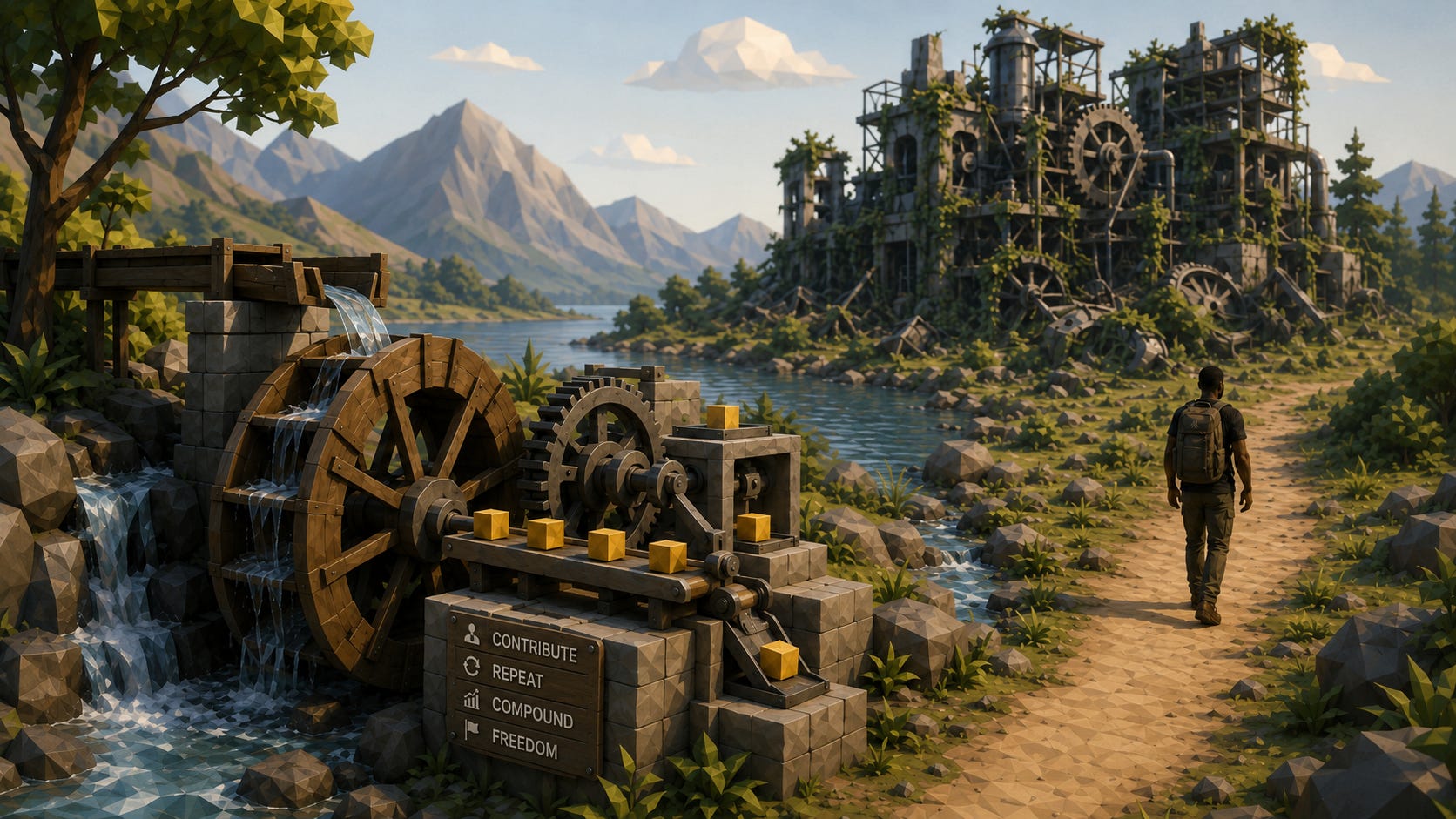
Between those moments, the system should be allowed to work.
A good system gives attention a schedule, so anxiety does not get to choose one.
With a rhythm, you know when the system will be read and when decisions will be made.
Not everything deserves immediate access to your attention.
That is part of what maintainability means.
Simple enough to keep, useful enough to trust
The goal is not the simplest possible system.
A single unexplained number may be easy to maintain and still be useless.
The goal is elegant sufficiency.
Enough information to know where you stand.
Enough structure to guide the next decision.
Enough history to understand what changed.
And little enough friction that keeps you using it.
The right balance will be different for each person.
Someone beginning with one investment and one recurring transfer may need very little.
Someone managing several platforms, asset types and long-term projections may need more.
The system should match the person, the purpose and the stage of the journey, not the other way around.
It should not require you to become someone else in order to maintain it.
The system does not need to impress you.
It needs to support you.
It does not need to capture everything.
It needs to preserve what matters.
It does not need your constant attention.
It needs a rhythm you can continue.
The real test comes later, when the excitement has faded, life becomes busy and no one is watching.
Can you still open the system, understand where you stand and make the next decision without feeling that you have returned to unfinished work?
A maintainable system does not try to control every possible future.
It helps you keep reading the present without becoming exhausted by the process.
It grows when genuine needs appear.
It removes what no longer serves.
It earns its complexity.
Then it gets out of the way so life can continue.
The best system is not the most sophisticated one you can build.
It is the simplest one you can trust, maintain and keep alive.